
 |
 |
 |
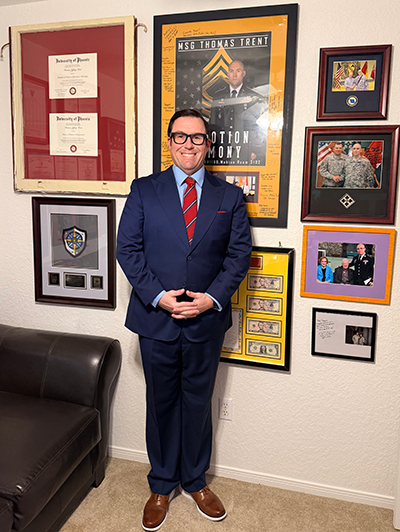
In 2002, newly married and lacking a sustainable path to care for my family, I reignited the desire to serve in the United States Armed Forces; this time, rather than follow my father into the Navy, I decided to join the United States Army. I cannot overemphasize my lack of preparedness to join an organization whose sole function is to fight and win the nation’s wars. At this point in my life (24 years old), I had never even been away from home. In fact, I did not even know how to wash my own clothes. Better still, I enlisted in a military occupational specialty (MOS) in the information technology field and had no idea how to turn on a computer. At this point, my confidence was in the Army basic training process and in my future Drill Sergeants, who would help me transform from a going-nowhere civilian into a Soldier. They did an excellent job!
Although they did a fantastic job shortly after reporting to basic training, it was clear to me that my self-confidence was a huge problem, and it led to a significant decision early in my initial training: would I continue training or pursue a dismissal for failure to adapt? Presented with such an important decision early on, I called my dad (a U.S. Navy Vietnam Vet) and asked for his advice. At the risk of stating the obvious, I continued to train, and it would be one of the best decisions I ever made.
Remaining in basic training led to my graduation and attendance at advanced individual training at Fort Gordon, Georgia. There, I learned the basics of information technology in general and, specifically, how to support users and nodes within the context of long-haul transmission systems (the AT&T of the Army). At this point, I was progressing very well and earned positions of increased responsibility. As my training ended and I prepared to join my new unit at Fort Hood, Texas, I was becoming more self-confident and learning how to succeed in the Army. Just before graduation, the lives of every U.S. service member would change dramatically; the U.S. invaded Afghanistan, and the world demonstrably changed for the next 25 years.
Over the next few weeks until graduation, we would gather in the day room to shine our boots and watch the invasion unfold live on the television. Our drill sergeants were not so subtle in pointing out that we trained for war, and now we would get our chance to prove ourselves as Soldiers. Overall, I remained immensely proud of myself and woefully ignorant of how my family’s life would be forever impacted. Eventually, I graduated and reunited with my wife in Bakersfield, California, before I embarked on the journey to Fort Hood, Texas. On Christmas Eve of 2002, I signed in at Fort Hood, Texas, and began a journey that would lead me to hold every rank and serve in every leadership position from Private to Sergeant Major.
I got off to a slow start, but learned to leverage training and certifications to my benefit. I learned early on to make myself useful in any capacity the Army needed me. I quickly established myself as a go-to subject-matter expert and someone who could be relied upon as an asset to the organization and the Army as a whole. At this point, I began advancing through the ranks, earning a promotion to Sergeant and learning the subtle realities of being a junior leader in a traditional, hierarchical organization. I soon learned to understand and comprehend what was not expressly stated by my superiors, and to grasp the highly nuanced language of leadership expertly.
I soon earned a promotion to Staff Sergeant (E-6) and was firmly established as a sought-after leader in my field. At this point, I was taking advantage of as many opportunities as I could, and while I had no idea whether they would come to fruition, I wanted to position myself to take advantage of them when they did. My career trajectory changed significantly when a former senior leader of mine reached out and encouraged me to take advantage of an opportunity to be a plank holder in the Army’s initial foray into the cyber domain. In the Army, the use of the word “encourage” is a not-so-thinly veiled and highly nuanced way of ordering someone to do something while allowing them the illusion of choice. Likewise, I dutifully applied because my leaders had not failed me yet. Although I was unsure I would be accepted because the Army was only accepting 28 Soldiers nationwide, and they had invited over a thousand Soldiers to apply.
I got accepted.
Over the next ten years, I would earn four promotions, rising from middle management to the executive suite and the absolute pinnacle of an enlisted person’s career. In 2021, I surpassed many of my mentors and peers and earned a coveted, highly selective seat at the United States Army Sergeants Major Academy. The only pathway to a promotion to Sergeant Major was successful completion of the course. Only one percent of Soldiers in the entire U.S. Army are Sergeants Major, and your assignments and potential reflect your performance in the course. Once again, I improved my performance and graduated in the top 15 percent of the top 1 percent of Soldiers in the entire Army.
A considerable part of my success was consistently positioning myself to capitalize on opportunities. I was able to do that very strategically and successfully by leveraging my Army training and hands-on experience alongside a formal education. Over the years, I have used formal education to become more well-rounded and to build on the training and experience I have gained in my career field. I grew up and learned on the battlefield of Iraq, where experience was a premium. Like Clint Eastwood in the movie Heartbreak Ridge, I did not go to university for learning; I learned in combat and trained at “Heartbreak Ridge”. After earning my Bachelor’s of Science in information systems security and an MBA, I decided to pursue a PhD in Clinical Psychology so I could further leverage my experience, training, and passions to understand what truly motivates people and how I could leverage that to propel myself and others to greater and more elite accomplishments. Over the course of my career, I have been able to directly mentor and coach over 20 non-commissioned officers (enlisted) and officers (commissioned and warrant) to achieve elite and unparalleled results in their careers. These are the ones I worked with one-on-one; I indirectly coached and mentored thousands through my numerous leadership positions and influence at every level within the U.S. Army.
Despite all my personal accomplishments, one stands out among the others. Early on in our marriage and careers, La Shawn and I discussed our desires. We articulated to each other the importance of advancing in our careers and developing and maturing our relationship. So, we committed to having our cake and eating it too. Over the next 25 years, we grew our relationship and our careers despite rarely being in the same state or on the same continent together for more than a few weeks. We are the poster couple for maintaining our careers, achieving unprecedented success, and growing our relationship simultaneously.